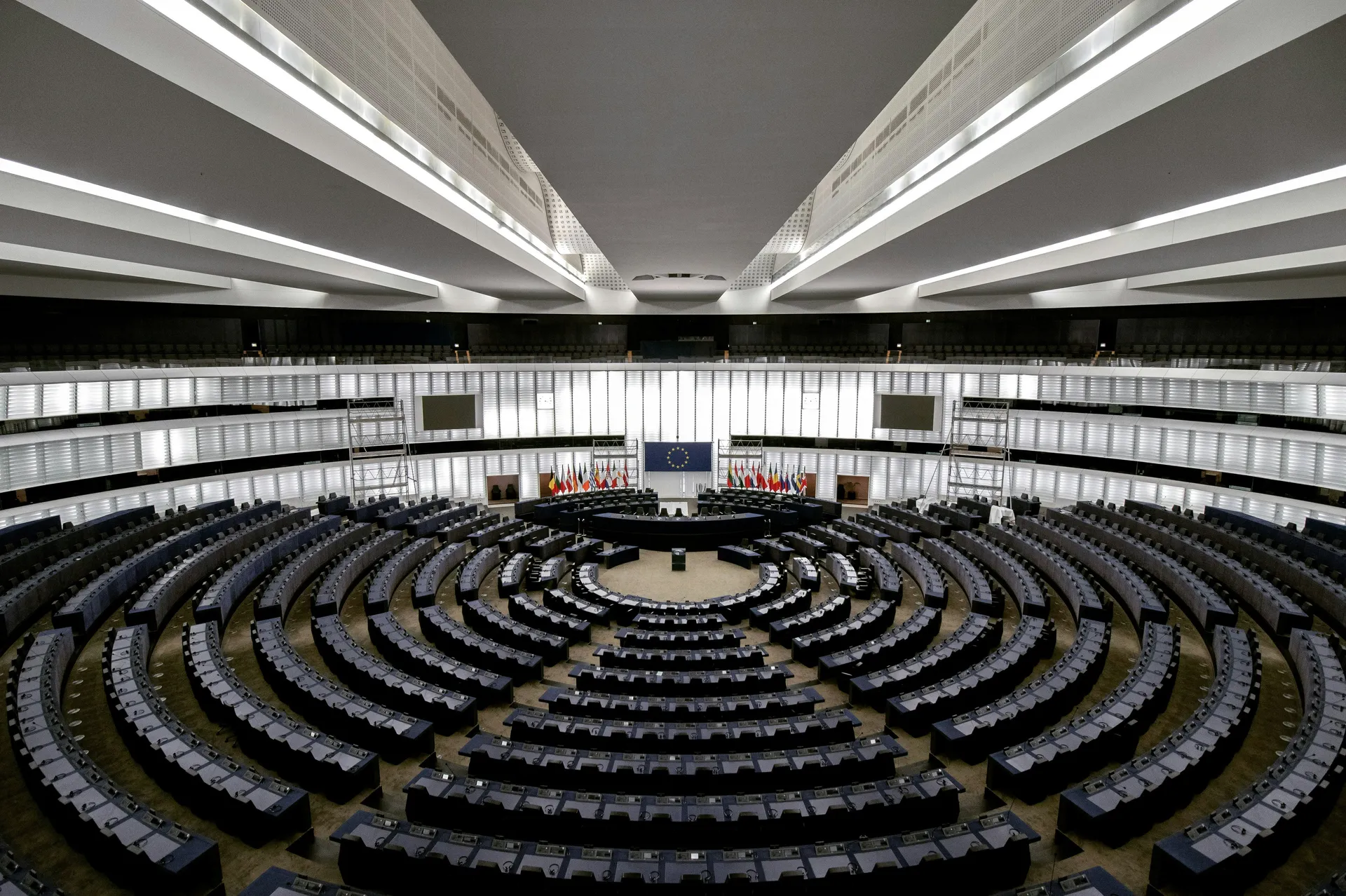
Are MEPs taking
AI seriously?
AI capabilities are advancing at a pace few predicted, and many now expect these systems to rival human cognitive work within a decade or two. A technology this transformative demands serious attention from the people writing Europe's laws. So are Members of the European Parliament actually engaging with it in a way that reflects what is at stake? This tracks every time one has, on the record — who, when, and in what words.
- 83
- statements
- 63
- people
- 10
- political groups
- 2023–26
- period
| Q2 2023 | 8 |
|---|---|
| Q3 2023 | 1 |
| Q4 2023 | 0 |
| Q1 2024 | 2 |
| Q2 2024 | 0 |
| Q3 2024 | 0 |
| Q4 2024 | 0 |
| Q1 2025 | 1 |
| Q2 2025 | 1 |
| Q3 2025 | 1 |
| Q4 2025 | 2 |
| Q1 2026 | 1 |
| Q2 2026 | 55 |
| Q3 2026 | 11 |
What do MEPs say?
We now witness the meteoric development of generative AI. We know it will have a massive impact on the world as we know it, and we also know it is only the beginning of this technology. It will keep on leaping many times over. […] It is no doubt the most disruptive and consequential technology in our history to date.

The exponential growth of AI is unlike anything we've ever seen in human history. […] Falling behind in the AI race would be like missing out on the Industrial Revolution 100 times over.

Half of all AI researchers said in a 2022 survey that there is a 10% chance that AI could lead to the extinction of humanity. Which of you would still get on a plane in such a probability of a crash? […] This is precisely why there are rules on aviation safety so that we can use this technology safely.

If in the 20th century sovereignty was defended with tanks and cannons, in the 21st century it is also defended with algorithms, semiconductors or data. […] deciding who develops the artificial intelligence that protects our critical infrastructure - hospitals, parliaments, banks - is not a technical issue, it is deeply political and existential.

Which political groups?
of 63 people · group at the time they spoke
Who raises it most?
- 01Dragoş TUDORACHERenew4
- 02Sergey LAGODINSKYVerts/ALE4
- 03Brando BENIFEIS&D3
- 04Reinier VAN LANSCHOTVerts/ALE3
- 05Alexandra GEESEVerts/ALE2
- 06Isabel WISELER-LIMAPPE2
What is this?
Advanced AI may turn out to be one of the most consequential technologies of the century — not just another tool, but something capable of transforming work, science, security and the way power is distributed. Whether the people writing Europe's laws are engaging with that prospect is a question worth answering with evidence.
This project draws on the European Parliament's public record — speeches given in the chamber and written questions put to the Commission. We surface the members who treat advanced AI as genuinely transformative, with far-reaching implications for security, society and the balance of power — not those who frame it merely as an economic opportunity or wave it away as hype. Each statement's key passage is highlighted, and every one links back to the original source.
This is an evolving project. If you have input or suggestions, want to correct something, think we've missed a statement, or have any other query, we'd like to hear from you.